When could you stop working?
See what you could receive and test real decisions: stop working earlier, reduce your hours or spend more on what matters to you.
Neto brings your full financial situation together to show how your income and net worth could change.

EXAMPLE OF A PERSONAL PLAN
You could stop working at 61
Your savings would cover the 6 years until your public pension starts
You would keep a buffer for unexpected expenses
How does neto.es arrive at this answer?
Thousands of calculations. One clear answer.
neto.es projects month by month how your income, expenses, savings, investments, property, taxes, contributions and pensions could evolve, consistently applying the Spanish rules it has modelled. This gives you a clear view of how your financial future could unfold and lets you test how different decisions could change it before you decide.
See your whole retirement in one picture.
Salary, savings, investments, property, private pensions, taxes and the public pension all matter at different times. Neto brings them onto one timeline, showing how each stage is funded and how one decision changes what comes later.
Because every plan is different, Neto gives you a personal answer based on your whole financial picture: when you could stop working, what you could spend and whether your money could last.
Build and evaluate your plan in three steps
Neto turns a complex financial situation into a simple process: understand where you are, shape your decisions and see how the outcomes change.
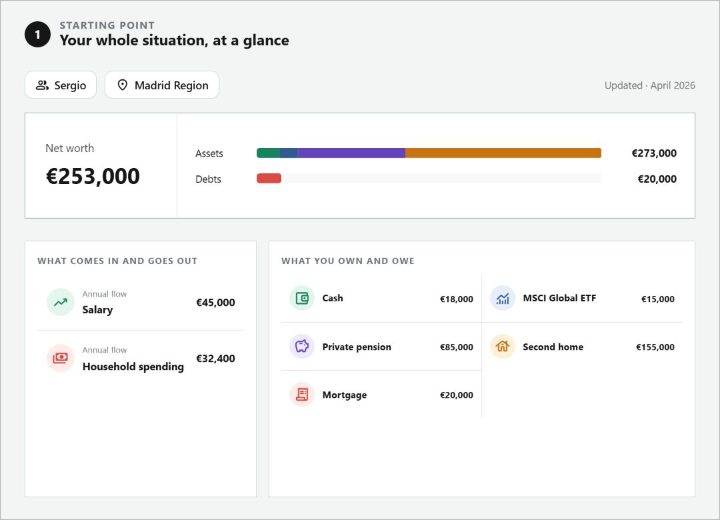
1. Bring your complete current situation together
Income, spending, cash, investments, private pensions, property and debts form one shared starting point. Every alternative is evaluated using the same information.
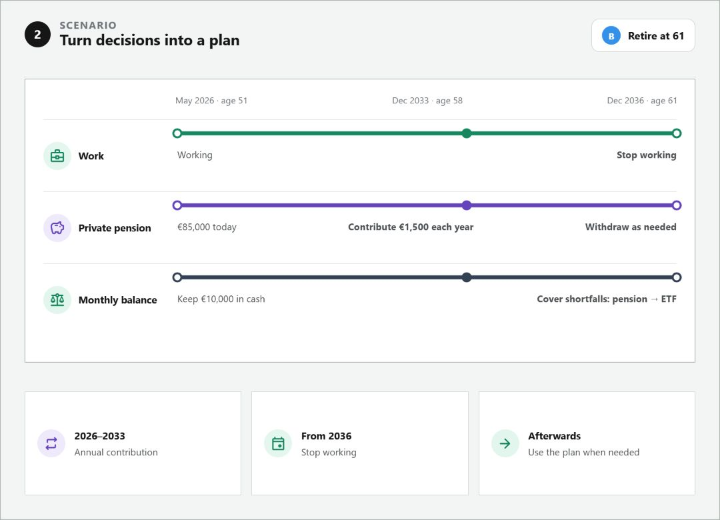
2. Shape your retirement plan
Explore a wealth of possibilities for planning your financial future: when to stop working or reduce your hours, how much to invest in stocks, ETFs or funds, when to draw on your private pension, and whether to buy, sell or rent out property. Adjust your spending and choose which savings to use first. Neto brings all these choices together into one connected retirement plan.
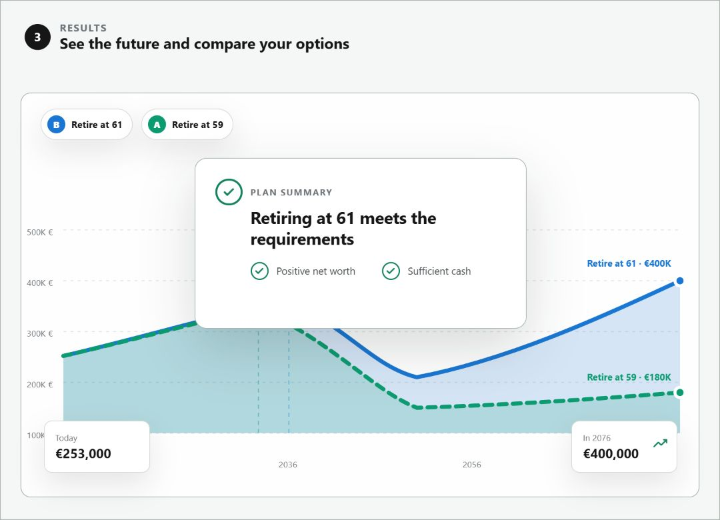
3. Check the result and compare alternatives
See whether the plan meets your requirements, follow how your net worth could evolve and compare what changes if you make a decision earlier or later.
Your retirement plan, now conversational.
If you’d like, connect ChatGPT to neto.es and describe in your own words what you want to set up, compare, or understand. ChatGPT can help you compare different retirement ages, understand your public pension options, review how to fund the bridge years, or see what the results say about whether your plan is feasible.
neto.es is the financial engine behind the conversation. It keeps your retirement plan structured, consistently applies the Spanish financial and tax rules it models, and performs the calculations for your plan. This keeps the projections consistent and reliable.
It is a powerful combination: the ease of a conversation and the strength of a financial engine. This lets you quickly build a model of how your retirement could unfold and focus on what really matters.
Take control of your retirement plan.
Peace of mind does not come from predicting the future, but from having thought it through, compared the options and put the plan to the test. With Neto, you can build a plan you understand, keep it under your control and continue adjusting it as your life changes.
'%3e%3cg%20transform='rotate(20%20160%20160)%20scale(.8)'%3e%3cpath%20d='M20%2040h110c-20%2040%2010%2085%2055%2085s75-45%2055-85h120v120c-40-20-85%2010-85%2055s45%2075%2085%2055v120H240c20-40-10-85-55-85s-75%2045-55%2085H20V270c40%2020%2085-10%2085-55s-45-75-85-55Z'/%3e%3c/g%3e%3c/g%3e%3c/svg%3e)

Build your own retirement plan
Bring your income, spending, pensions, savings, investments and property together. Test when you could stop working, and see what each choice changes.